Thursday, 19 September 2013

On to the Tuamotos and Society Islands

The town of Hakamaii lies on the western shore of the island off Ua Pou. It is not a popular stop because of its exposure yet we landed on the beach to check it out and we were welcomed with much attention. After earning respect by landing the dingy safely on the steep, surf pounded, rocky beach we chatted with all the local kids and fisherman. The town consists of a beautiful church overlooking the bay, a school, post office and reportedly two stores. We followed the stream up the paved road through the nicest little town you could imagine. The immaculate yards are abundant with fruit trees and the street and stream valley are covered in mangos and breadfruit having fallen from the trees. The porches were filled with locals who looked surprised to see us but when we waved they giggled and enthusiastically waved back. As we were reaching the top of the town a family on their porch gestured and cried “kia kai, kai kai” which is Marqusean for “eat eat”. We almost hesitated but the family’s enthusiasm was too hard to refuse. In a few moments, after introductions and the kids being sent off to play, we were seated in front off a spread to rival any Thanksgiving feast. There were plates of fruit, caldrons of pork and beef along with the best octopus I have ever tasted.  The wine flowed freely and we were able to communicate through the youngest brother visiting from Paris. He and his family live in Paris and he has spent the last 18 years in the French military. He summed up the Marquesas Islands beautifully, “in the rest of the world no money - no eat, in the Marquesas no money but plenty to eat.” As we were leaving, the family packed two boxes of mangos and bananas as a parting gift.

We had spent a number of days waiting for better weather for the crossing and had a great end to our Marquesian visit but we were anxious for the adventure of being at sea. At 0900, August 8, with both anchors aboard and all ship shape we departed Baie Hakamaii twenty minutes behind Ichiban for the 5 or 6 day crossing to Fakarava in the Tuamotus.The first two days out were perfect sailing, 12 knots of wind and we sailed along at 4-5kots through calm seas heading us well to windward of our destination. We had timed our departure to coincide with, what I thought was, a mild and short lived weather front that would give us brisk sailing down and calm seas when we arrived. But at 1800, our third day out, the sea told us differently. Over the course of an hour the wind increased from 12 knots to the forecast 15-20, and didn’t stop till it was raging a near gale at over 30knots.
We now had the adventure we had signed up for and the next 3 days gave us ample opportunity to test our boat and our storm tactics. The first night we shortened sail and ran down wind with the seas. This is the easiest thing to do but created a challenge that if we didn’t make some progress across the wind we would miss our destination not to mention all of French Polynesia. During the night the seas built and the wind didn’t moderate. I spent the night listening to the noises of the ship and sea and watching the shadows of the waves. It was a little scary but we only shipped one wave into the cockpit (drenching me) and still Suuhaa instilled confidence.

In the morning we had to head the boat back to windward, so we headed up and spent the day clawing up and over 4 meter seas in the hopes we could still make our destination. By that night we were exhausted so we hove to. This is a storm tactic using the sails to stall the boat and balance it so it stays oriented about 45 degrees off the wind, slowly drifting to leeward. Easier said than done, but with the help of a 6 foot cargo parachute streamed off the bow we were able to get the boat stopped and oriented properly. Once hove to, in the face of this heavy weather we had dry decks, turned the anchor light on, cooked a decent dinner and we both slept soundly. The next morning, well rested, we were back smashing and pitching over the breaking seas and back on course to Fakarava. The only change was it would be the western entrance and not the eastern one as planned. By that afternoon we spotted Kuehi atoll and by evening had made it inside the island group. After heaving to again for the night we made Passe Garue at the end of the flood tide the next morning.

Sailing in and around atolls presents two navigational issues to contend with; one is getting through the pass into an atoll; and two, is where to anchor once inside. It is best to make the pass at low slack water so the following flood will lift you off a reef if you do go aground. The sun should be high in the sky so you can see through the waters and spot the uncharted coral heads. A calm sea outside the atoll is preferably as the swell
breaking over the reef causes major problems for predicting slack tide. When anchoring, you need to be on the weather side so the wind blows you off the beach and not onto the beach. Upon making Passe Garue, the only thing we had on our side was the sun high in the sky but that was useless because the wind whipping on the surface of seas made seeing the coral impossible.

We had chosen Fakarava as our destination because it well charted and has two wide deep passes, a perfect “beginner” atoll.  So in we went, with sails drawing and the engine at full throttle we pounded through the pass. Once again proving her strength, Suuhaa drove her nose into the bright blue waves and tossed water all over the decks without so much as a shudder. Inside however, we realized the weather was way too heavy to ride at anchor so in a moment we made a decision, tacked and headed straight back out the pass for the safety of open water. This was the end of our Tuamotu experience. We had few options other than waiting for the wind to calm down but decided to skip the whole ordeal and use the wind to get us to Tahiti. Our visa is only good for three months and typically cruisers spread this out over the 3 archipelagoes: the Marquesas, the Tuamotos and the Society Islands. But we had spent 2 months in the Marquesas and knowing that we will be spending many months in atolls later in the trip, we hadn’t actually thought to spend more than a few nights in the Tuamotos and so we weren’t heartbroken with this decision. We headed Suuhaa south west and within a few hours were charging along, leaving 6 miles an hour in our wake, toward new adventures on the well developed island of Tahiti.

Three days later, after an overnight stop at the small village of Tautira on Tahiti Iti, we anchored off the Tahiti Yacht club in a suburb of the biggest city in the tropical south Pacific, Papeete. We spent about a week here spending money resupplying with stores, spare parts and propane. Considering this is the only “westernized” city we have seen in 3 months and the only one we will see for another 6 months we got away for pretty cheap.

During this time in Papeete our minds were on our friends on Ichiban. During the passage, shortly before the gale hit, we had lost radio contact with them. This was on August 11 and it was now the 20th and we had not heard from them. We were sure they were safe on one of the atolls and probably didn’t have internet access but still we worried and just to be safe we reported them overdue. The Yachtmaster in Papeete was of great assistance translating emails and forwarding them to the MRCC (which is the search and rescue department of the French navy!) who within 3 hours had located the captain of Ichiban by looking on his face book page! Well, we felt a bit dumb for not trying this ourselves but were very happy to hear they were safe on Rangaroa atoll. We continued to send them e-mails but with no response we figured the internet was spotty.

With our chores done and both agreeing that having fun in cities is proportional to one’s disposable wealth, we left Papeete and the island of Tahiti for the 25 mile crossing to Moorea. Just out of the pass we set our course, raised our sails and saw we were on a collision course with an incoming sailboat. As they got closer I realized it was Ichiban! We pulled along side, and after shouts, cheers and applause, talked them into skipping city life and coming straight to Moorea with us.


Moorea has long been known as gem of the South Pacific. Its fringing coral reef contains crystal clear water with a back drop of spectacular volcanic mountains. Its popularity as a tourist destination began with Captain Cook and continues to this day. During our stay we hiked, hitchhiked, swam, snorkeled and sampled the local pizza. The highlight was feeding the sting rays and reef sharks.  The tourist tour boats have tamed and trained these animals and they show up on a shallow sand bar every morning looking for breakfast. We arrived before the tour boats and jumped in the water with a bag of stinky tuna. The sharks showed up first but
luckily they were pretty timid. For some reason the stingrays loved the girls and within ten minutes were swarming all over Tra and Anna who were stuck, holding onto the rail of the dingy to scared to put their feet on the bottom. Justin and I were in tears listening to them screaming as the rays and tickled them with their wings. Although I finally had to rescue Tra by throwing her back in the dinghy she agreed it might have been the highlight of the entire trip.

 The Leeward Society Islands

We left Moorea behind us and sailed overnight to the island of Huahine, the first island of the leeward group. We had read that this was the “surf cruiser’s” anchorage and we also hoped to find opportunity to meet and create friendships with locals on this smaller, less developed island. Our sail over was rolly-polly which made me a little sick but the wind was steady and kept us pushing along. I did spot a flare as it lit up the night sky which gave Brad the opportunity to communicate with the French navy again. The flare was blue (not a red which would indicate distress) so the navy wasn’t too worried though neither were they willing to tell us what was going on. As dawn broke we were just off Huahine and were first greeted by pilot whales and then humpback whales. The pilot whales didn’t stay long but the humpback whales were all over. Quite a welcome! We came into the lagoon off the village of Fare and dropped our hook in crystal clear water.
Ichiban arrived a couple hours later and once again we were neighbours.

We kept ourselves pleasantly occupied during our two week stay in Huahine. There are the surf breaks, which, even to my non-surfer’s eye, could tell you are incredible and the local surfers on the island ride these waves like pros. One break in particular curls over into a perfect barrel and one of the most amazing things we saw was a local surfing in a barrel five feet over his head. Captains Suuhaa and Ichiban had many sessions on these waves (when they weren’t way overhead) returning afterwards with smiles and only minor injuries from the reef.

It was coming back from picking them up after a mid-morning surf session that we happened upon some friendly locals partying in the lagoon. Now, this is something each and every one of us needs to experience. We were waved over, given ice cold beers and everyone got to know each other while standing chest deep in the temperate waters. The music played, everyone laughed and after two hours and t-shirts for everyone, we said our goodbyes and went back to our boats for naps. It was, after all, siesta time.

It wasn’t all surfing and boat parties (though we did have a few, making new cruising friends in the process – Hi Whit!) on Huahine. During the better part of our stay the winds coming down the mountains and off the island were extremely gusty. Our wind meter clocked the speed of one of these gusts at 34 knots (that’s just over 60km/hour for you non-boaters out there). That’s a lot of wind when you have your anchor in only six inches of sand. There were a few nerve-wracking nights as we kept anchor watch and Suuhaa swung around in the wind. Below us, which is easy to see in this clear water, were also numerous pieces of coral and we could see our anchor chain wrap itself around this one and that one only to unhook and wrap around another piece or two. While snorkeling over our anchor one morning, we watched as our chain, wrapped a few times around a piece of coral rock, pick up and move this rock. There was some fancy maneuvering when finally decided to head out from Huahine a few
days later.

We had a boisterous 25nm sail from Huahine to the island of Tah’aa. Admittedly, I felt a little sick again; but, small price to pay to travel as we like through the south Pacific. The wind was perfect and we sailed inside the reef up a long inlet where we anchored at the end in some deep sticky mud and slept soundly through the night. We were up early the next morning anxious to move on to Bora Bora only another 20nm away.
Bora Bora is beautiful but I have to admit that we have been surprised at the difference in attitude from the locals on both Huahine and Bora Bora from that of the people of the Marquesas. These islands, particularly Bora Bora, are very touristy and localism is strong. While the presence of tourists creates jobs and advances development, which some might think is a positive thing; the locals seem to resent the people visiting. In the Marquesas, where tourism is on a much smaller scale, the locals welcome visitors and are as interested in us as we are in them. From the books we have read, it very much used to be that way here, but Bora Bora is all hotels, every motu (small islands on the fringing reef) are all owned by the hotel situated on each and therefore private. And I really think the locals resent this complete take over of their beautiful island yet it has happened and they are wrapped up in it. The general character of Polynesian people is generous and welcoming and I have to wonder if they are sick of what they perceive as guests overstaying their welcome.

 As I finish this entry, we are preparing to leave Bora Bora. Brad is washing down the decks which are covered in ash. The large central mountain of Bora Bora is currently on fire. It has been burning for two nights; the wind keeps blowing, fanning the flames and unfortunately the fire keeps spreading. We will get our final clearance and outward stamps in our passports from the gendarmerie here, buy a few last fresh groceries and head to American Samoa with a stop at Suwarrow along the way. Suwarrow has been on Brad’s mind for awhile, it’s a national park belonging to the Cook Islands and is supposed to be beautiful. This passage to American Samoa will be about 1500nm with Suwarrow as break at about the 700nm point and we can’t wait.


Tuesday, 30 July 2013

Marquesan style


“A tourist remains an outsider throughout his visit, but a sailor is part of the local scene from the moment he arrives.”
- Ann Davison


Baie d'Anaho


So much for two weeks in the Marquesas. We expected beauty; we expected friendly cruisers and hoped for hospitable locals. I can tell you that what we have experienced has been way beyond anything you could imagine. We travel now in the company of two other boats and greet other cruisers as old friends when we arrive or they arrive in some ridiculously beautiful anchorage. As we sputter the French that I scantily remember from grade 9, the Marquesans giggle at us and welcome us into their restaurants, onto their beaches and even into their homes. 

In Baie d’Anaho, we pleasantly bobbed around on our anchor and breezes sifted through the open hatches. I had taken down the laundry I scrubbed at the tap near the beach yesterday while Bradley was off sniffing out mangos with which we made brew like the locals. Often we were going to leave “tomorrow” but why rush? We’ve been in these islands for almost two months, there’s no sense rushing through paradise.
Ichiban with Justin and Anna
Patrick on Ik'a
Visiting this bay had been a part of our plan for a while, since Tahautau. It was there we met an older French couple who are on their 4th pass through these islands. Brad charmed them with his extensive French – “Bonjour!” and they have been sharing their experiences and advice ever since. This was a bay they told us not to miss. Again, we had planned a short stay, maybe three or four days, and then we would sail on to the Tumatos. We were so sure that this was our plan; Bradley had even started to write something for that blog entry. We’ve been here two weeks. But why rush away? With our new friends, Justin and Anna from Ichiban and

Patrick from Ik’a, we have been poking around and enjoying ourselves immensely. We hiked over the ridge east of this bay to visit the beach in Baie d’Haatuatua which we had passed on our sail here. The blue ocean laps up this gorgeous golden beach, that I’ve tried to capture in a photo, but the water is full of jellyfish that get pushed in by the winds and current and the beach is teeming with nonos. Tiny bloodsuckers. They are relentless and the nasty red bite they leave itches like crazy for almost two weeks. I have learned that both coconut milk and lime juice are natural insect repellents. Grate a coconut, squeeze the milk from the gratings and rub all over. You smell good and your skin becomes baby-bottom soft and the nonos will avoid you! Lime works though after scratching existing bites there are a few moments of teeth-clenching stinging while you rub the half a lime on your scratched up skin.

Tra, Patrick, Justin and Anna
This hike was not just to soak up the view; we had also learned there is a farm just over the ridge. The friendly farming family gave us buckets to collect fresh tomatoes, eggplants, parsley, cantaloupe, watermelon, mangos, papayas and pamplemous. We just finished the tomatoes a couple nights ago. Maybe we should go back for more and stay just one more night. We’ve also hiked over the ridge to the west. Patrick, our tireless interpreter, had become friendly with the guide who took him pig hunting and we would go there to visit him. When we had first learned of Patrick’s adventure, Bradley’s eyes lit up and I knew that we couldn’t leave these islands until he had gone pig hunting in the hills of Nuka Hiva. We hiked the switchbacks straight up the ridge and we’re rewarded with a fantastic view of Baie d'Anaho and only our three boats anchored below. The hike down was full of pauses as we picked mangos, sliced and devoured them. We arrived at Nui’s place in Baie d’Haithau after a brief beer break and some deep fried shrimps at the only restaurant.

Baie d'Anaho
Horses, puppies and a most welcoming host determined our tentative plans to stay the night. There was, after all, a party at the community hall for Bastille Day to attend. Music, dancing, bbq and the drinks particularly, ensured our place in local history proven by the waves and shouts of “Brad Pitt warrior!” (You can ask Bradley about the particulars later) we heard the next day as we began our walk back home to the boats.
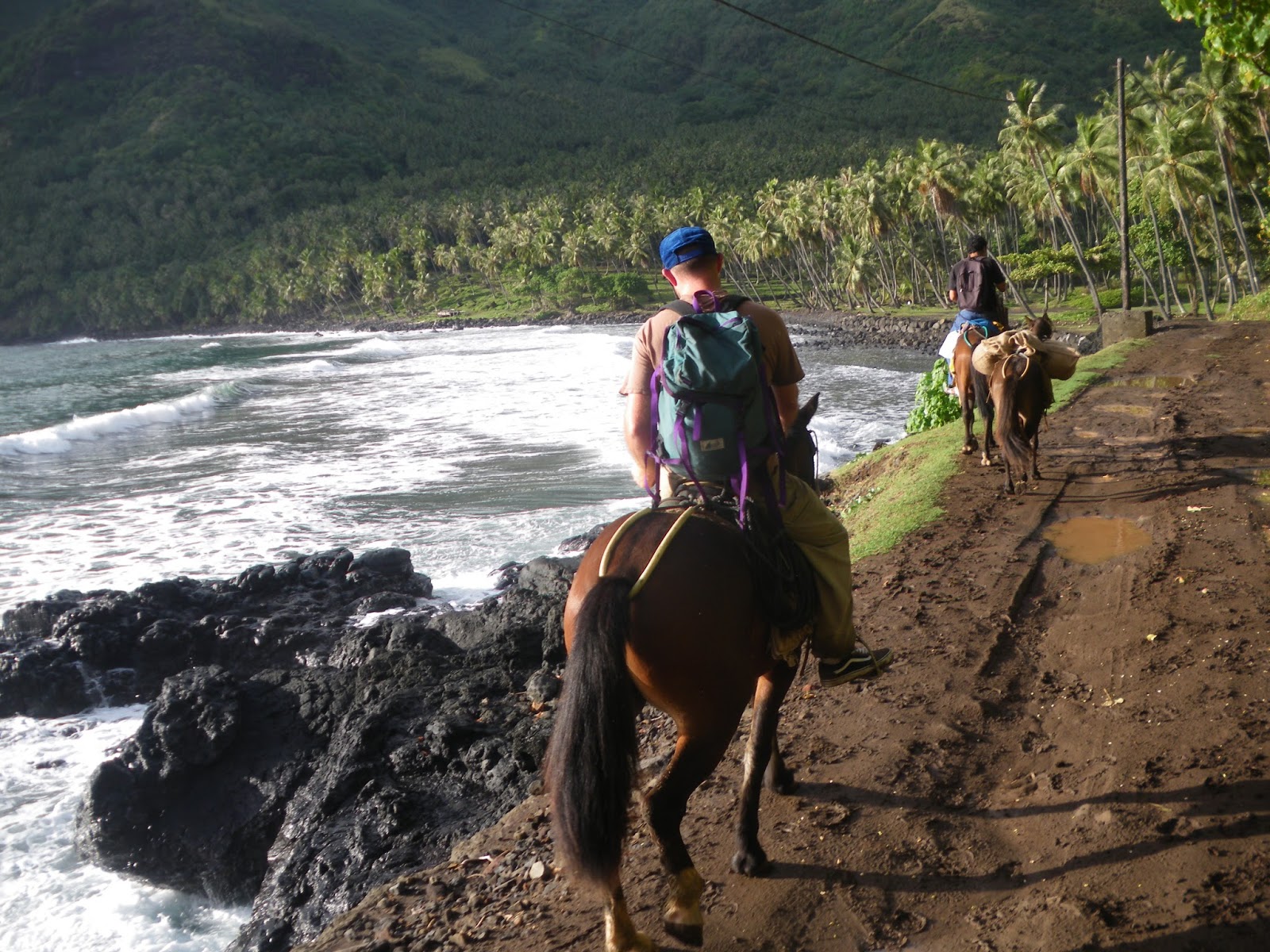
Bradley and I returned to Baie d’Haithau two days later for a horseback riding, pig hunting adventure with Nui, leaving our sweet Suuhaa in the care of our friends. I had no plans to pig hunt but we figured a three day horseback ride through the gorgeous Nuka Hiva environment could not be missed. At Nui’s place we were served lunch, offered a shower and introduced to our horses. Gringo for me and BonBon for

The view from Nui's kitchen window.
Bradley. Nui would ride his horse and his new young
unbroken horse would be our packhorse. It was about 5:00pm when we left and would ride for 3-4 hours to the beach where we would sleep. It got dark quickly and it began to pour down thick tropical drops of rain. It’s very warm here, we weren’t cold and our jackets kept us dry. The problem with the rain was it determined where we could sleep which was not on the beach but on the concrete floor of a wall-less shed. Nui carefully spread out the damp burlap sacks which had been between our WOODEN saddles and the horses’ backs, with me getting a couple extra for “comfort.” I didn’t sleep that night, Bradley, who is made of tougher stuff, snored happily away to the sounds of the waves breaking on the beach in front of us.

In the morning Nui made us coffee and we snacked a small breakfast before saddling up and beginning a 5 hour ride. We rode up through a peaceful village of about 100 people to a single file trail into the jungle. About 100 feet up this trail, Nui stopped and told us that we would need to go fast up this part, gestured that it was uphill and we should hold on to the mane of our horses as we went. Holy crap, this trail was straight up and the horses needed to gallop to make it. I’m pretty sure I had my eyes closed, trusting that Gringo knew her way and would keep up with BonBon and Bradley. At the top, we slid off our sweating horses to give them a break, collected our shaken wits and looked around. We were on top of a high ridge, high enough to see bay after bay and miles of ocean. This island is stunning. 

Up and down mountain ridges we rode. Under low hanging branches, over coconuts and were rewarded each time with a break in yet another beautiful bay. The final ride down was into the valley Nui’s family owns, 800 hectares of paradise. The valley falls steeply into lush greenness and then opens to a beautiful beach on the ocean. Nui’s father opened his home to us even giving us his bed to sleep. I’m pretty sure that I was the reason for such generosity. Our friend Patrick had slept in a much more rustic place and I feel confident assuming that if Bradley had been alone he would have shared that experience – not the soft big bed experience. Oh and I had a shower. A long fantastic shower which was worth more to me than hunting down a pig. Alas, the pig hunt did not happen. But while we were sitting in the shade drinking fresh lime-ade and devouring pamplemousses, Nui and Bradley discussed having a true Marquesan experience. As can be expected, some things were probably lost in the translation and it was on our way back from our little walk to beach later that Nui’s dad pulled up to us in his pick up. Through gestures and a few key words Bradley realized what was being asked. Would he like to go with him to shoot a bull? We jumped in the truck, Bradley in the front and me in the back next to the Winchester, yup – loaded. With uncles, brothers and cousins in the back, we bumped back towards the beach to where the all the bovine hang. Everyone disembarked but I stayed in the truck listening to the radio. This was going to be a little beyond my capacities. I did hear the two shots and shortly thereafter a brother came to get me and the truck. Back we drove across the field to the gang of paradise ranchers standing around a dead bull with Bradley smacked dab in the group – grinning. The truck was backed up and everyone (but me, again, I stayed in the truck facing forward) heaved and hoed and hoisted that massive beast into the back of the truck. We drove 50 feet to a tree with a strong low branch. This is when Brad opened my door and said that I probably would want to go back to the house. I bounced out of the truck and never looked back. I went and had that glorious shower and a nap. 

Now, I wasn’t there to see the slaying or the butchering of the animal but Brad told me that it was pretty awesome to see.  First, when they all left to shoot the bull, it definitely wasn’t a hunt; more of a wandering around picking out bulls and then discussing if that bull was a good choice - sort of like shopping. After a consensus was reached, the uncle leveled the gun and POW POW, Mr. Bull went down. They bled him then and there and that’s when I showed up in the truck. After I had walked away, they noosed that poor beast and hung him from the tree. It was a family affair as the bull was butchered, solely with machetes (no sawzalls!), and quartered and divided up between the families. They didn’t give Bradley a machete but one older uncle hacked him off a piece of rib eye, squeezed a lime on it (which he cut of a tree that was right there) and Bradley snacked on raw beef. Brad came back dirty and a little bloody and pretty pleased with this true Marquesan experience. Needless to say later that night we dined on fresh fillet mignon for dinner. 

We rose early the next morning, helped Nui saddle the horses and began our 5 hour ride back to his place. It was a long hot ride, Brad got stung in the neck by a wasp (this was actually the second sting in the neck – I guess he’s not allergic) and also had technically difficulties with his riding equipment a couple times. During the second incident the pack horse he was leading decide to stop and have a snack while we were galloping up hill and Gringo’s reins came apart and a stirrup broke and our man was tossed to the ground. Not to worry, he stood up mostly ok. Poor Nui was mortified and the horses were shouted at but Bradley dusted   When we finally arrived back at Nui’s, we were feed more fresh beef, offered a shower and a nap before a hot hike back to Baie d’Anaho and our floating home. We were fortunate once more since during a brief stop at the store before the hike we saw a young guy we had met at the party and he offered us a ride in his speedboat back to Baie d'Anaho. This is no sweet trip around the corner; we came out of Baie d’Hatiheu and around Point Temoe into seas Brad says are like those around the Charlottes. Jacob expertly navigated the swells, the waves and currents and saved us a sweaty and buggy hike. 
himself off and was reaffirmed in his decision to be a sailor – not a cowboy.

We stayed in Baie d’Anaho a few more days. New local friends Brad had made when he worked on their outboard had us over for dinner, gave us copious amounts of fruit and half a goat. We were also given a bottle of Raiku. Raiku is the local brew. The alcohol is very expensive here and the locals make and drink this “coconut beer.” It’s not really legal; I would liken it to moon shining. It can be made with anything growing on the island. Coconuts, breadfruit or even mangoes which are what we have been using. We have had gifts of many different varieties and some have been terrible (very vinegar-ie) and others have been delicious. Justin on Ichiban is also working on mango version and he and Brad have many discussions about their mash and when it will be ready. Actually, the first batch was ready a few days ago and the five of us had a great time drinking MangoHooch that Brad brewed. We are looking forward to Justin’s vintage as it should be ready next.
 
Currently we are back in Baie de Taiohae after circumnavigating the island with Ichiban and Ik’a with a
couple of stops along the way. We will re-provision here, use the internet and phones and then continue to the Tuamotus soon. Our plans, as they stand at this moment, are to only stop for a couple nights in those atolls before moving on to Tahiti. Then again, we were only going to stay in the Marquesas for two weeks…

Tuesday, 2 July 2013

Les Îles Marquises


Ua Pou
To sum up the trip down from the captain’s point of view, crew and vessel exceeded expectations. I enjoyed every moment other than the calms, but 39 days is a long time. It is kind of a major thing but it doesn’t seem like a big deal now that we are here.  At sea each day is much the same as the day before. You just deal with things like you would anywhere else though land keeps getting farther away. The thing is, is that you can’t comprehend the distance; you always think that land is just over the horizon. I thought a lot about it after we arrived and figured I wouldn’t be talking Tra into a 40 day passage anytime soon but now, after 3 weeks here I think she would go in a second if told her there were islands more beautiful than these at the end of it. Anyway, Suuhaa performed, no major weather incidents and we caught more fish than we could eat. Good times all round.

We spent our first week in the Marqueses anchored in Baie Takauku, the harbor for the town of Atuona on the Island of Hiva Oa. We arrived late in the afternoon on a Friday and had resigned ourselves to be quarantined on the boat till Monday morning when the Gendarme would be back at work to clear us in. On Saturday morning I was up  
early with the skiff in the water and rowed over to a neighbouring boat flying the solid yellow “Q” flag (meaning they also were not cleared in) and soon found out from our new friends, Bruce and Cheryl, that all was good and as long as we checked in on Monday no one would mind if we landed. They had done some leg work and as it happened they were about to meet an agent who, for a very reasonable price, took care of it all: customs, immigration, bond exemption and a duty free fuel permit. Next thing we knew we were on shore hiring and supplying the agent with photo copies of our papers.

Atuona is the second largest settlement of the islands (pop 1500) and is a convenient port of entry for yachts arriving from the east. The harbor is frequented buy supply ships from Papeete, Tahiti and yachts anchor further into the harbor to accommodate them. There is a constant swell requiring you to set a stern anchor. The town, although reported to be half a mile walk is actually about 3km. We walked this numerous times but often would get a ride from a passing local. The town has a few stores, a hospital, bank, hardware store, post office, two restaurants and a Paul Gagnon museum. There were also a few vendors selling produce and eggs from the back of a truck.  

We spent our first week here getting organized but between the heat and being mute in French we didn’t get much done. Take internet for example, we bought time from the local provider who basically delivers the service via cell towers as a “hot spot” but with only one bar of reception it wasn’t possible to stay connected long enough to do anything constructive. In town we tried at the post office where they had a computer for public use. This was even worse as the letters on the keyboard were in all the wrong places and the written instructions and friendly human assistance were in French. After a half hour of getting somewhere in 90 degree heat the connection reset and we lost everything. I had a spaz and we went back to the boat. Frustrations aside, we enjoyed our first week immensely. We met many cruisers, all of who were very impressed we came straight from Canada (even though it is only 200nm farther than Panama). The first night was “cook’s night off” and we devoured French pizza accompanied by huge goblets of wine. As far as general comfort goes, we are in very good shape. I was worried about how hot the cabin would get but the breezes always seem to blow and keep the cabin a very comfortable temperature. The bugs have also not been too bad; they are terrible on the beach but the biting ones have not made it to the boat yet. Tra is my best insect repellent, they find her juicier than me.

Baie d'Hanamonea
We did make a short visit to the local hospital after I carved another Merganser gash into my right hand. We steri-stripped  it up and when we saw the doctor the next day, he promptly ripped them off, said it was too late for stitches (which I had repeatedly told Tra he would say) and sent us on our way, wound gaping once again. Keeping it dry the next few days was a challenge (there is a nice little surf break in Atuona) and Tra had to row the dinghy everywhere. This was a great source of entertainment for all the other captains in the bay.  At the time of this writing, it’s all healed up and I have a handsome scar as a souvenir.  


tikis
After a week in Atuona with supplies, stores, water (R.O. quit), and fuel on board we departed for the neighboring island of Tahuata. We sailed across the channel to the south and around the N.W. corner of Tahuata where slightly down the eastern shore lies what some have called one of the most beautiful anchorages in the South Pacific, Baie Hanamoena. We anchored in the middle of the bay amongst 12 other boats in crystal clear water. We knew a number of the boats from our stay in Atuona and were promptly invited to a beach bbq. 

We spent 4 nights in this paradise. Our activities included diving for lobster, fishing, and hunting chicken and wild boar. All of which we were miserably unsuccessful. During these pursuits we were able to enjoy some unexpected successes. While diving for lobster we got to see manta rays, barracuda, moray eels and a few 6 foot reef sharks. I caught numerous small fish though we did not eat them as the risk of Ciguatera poisoning is high in this particular bay. During our hunting escapades Tra was able to pick fruit which we are still eating.  The end of each day was filled mainly with drinking wine while strumming the ukulele for my appreciative audience of one. 
Chicken hunting


Wild limes

Our next stop was Baie D’Hakahau, the main harbor on the island of Ua Pou. After an overnight motor sail from Tahuata, we pulled in and set two anchors in what might be the shadow of the most dramatic skyline I have ever seen. Ua Pou was a nice stop and I got to catch a few waves at a surf break I could paddle to from the boat. We enjoyed a music festival and Marquesian BBQ. Best of all we found lettuce at the general store and had a massive Caesar salad for dinner! After 4 nights there we sailed the 25nm channel to Nuka Hiva.

Daniel’s Bay is located on the S.W. corner of the Island of Nuka Hiva. It has been a long time favorite of cruising sailors because of the awesome beauty, a hike to the third highest waterfall in the world and the warm hospitality of a local named Daniel. It was further made famous by a certain reality T.V. show. Supposedly the T.V. show flattened Daniels house so he’s gone. We made friends with a local couple and found out all the villagers got paid a bunch of money to move out of their homes for 3 months of filming. They all were pretty pleased with the cash.  We met Teiki and Kua on our hike up to the water fall as we trespassed on their property. Kua waved us over to talk, but it was her husband Teiki I was looking at and little unsure. Here came this dude with a Mohawk, giant bone through his ear and tattoos covering one half of his face, head and body. I was soon put at ease by his smile and we were then invited to lunch after our hike. 
Daniel's Bay


Wild boar hunting
The hike to waterfall was fantastic; it was 4-5km up a deep jungle valley along a trail built by a civilization I know nothing about. Everywhere you looked were the remnants of the stone platforms that the Marquesians built their houses upon. The entire trail was build like the sea to sky highway - on top of a wall. The waterfall plunged off a mountain top into a box canyon that was so high and narrow the sun only shines for a few minutes a day. After lunch we ended up spending the day getting to know Teiki and Kua. Teiki kept us entertained with coconut husking competitions and stories of his great hunting and fishing escapades. He gave me all kinds of fishing tips and I am now committed to returning to smuggle 22 shells for him. The next day we returned with gifts of fish hooks and chocolate chip cookies. 


After Daniel’s Bay we sailed in the company of two other boats for a squally 5nm passage to windward and arrived at the main town of the islands, Taiohae. Here we anchored amongst about 30 other boats to take fuel and provisions (water maker is working again!).  The demographic of the “cruising community” has been quite a surprise. We were pretty sure we would be hanging out with old people and often joked about this before we left. Turns out, there are lots of couples in the 55+ range but there are almost as many couples our age and many with multiple kids. Kids younger than yours too. I overheard a guy saying he and his wife are staying here for two months to deliver a baby! Wow! So our best hope of finding work is probably starting a floating day care!


From here we will be sailing around Nuka Hiva to Baie Anaho for a couple of days before we depart for the 500nm crossing to the Tuamotu archipelago. We are only planning a few nights there and will then continue to the island of Tahiti.
That's a hammerhead!